The Case for Collatz
Why is the collatz conjecture worth working on?
The crux of it is captured in this story:
In 1962, the nobel prize winning Lev Davidovich Landau was in a car accident which put him into a coma. When he awoke one morning, he found his son Igor next to him, and said “Igor, you are here. What is the indefinite integral of dx over sin(x)?”
Igor took out scratch paper and started working it out, but could not find the correct answer.
“Igor, you regard yourself as an educated adult, yet you’re incapable of performing such a simple task.” - Landau
How long have we studied integers for?
Sure, we can’t keep all of them in our brain at the same time, but we can hold incredible amounts of them in the memory of our computers, and do operations on them. We are very aware of their basic operations: addition, subtraction, multiplication, division, etc. These are the first mathematical operations we learn.
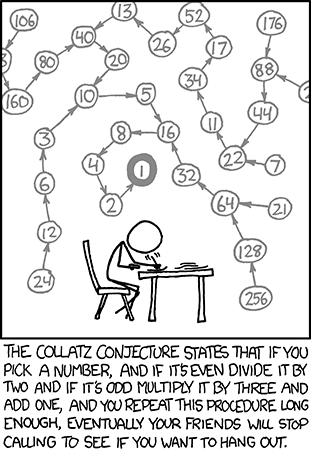
And yet a problem regarding such a simple formula, 3x+1, alludes us.
We have been to the moon. We are building artificial brains that may soon surpass our own thinking abilities. We are building the future, ticking off worldly challenges one technological innovation at a time. In short, we call ourselves educated. We think of ourselves as smart.
We should not consider ourselves smart until we have solved this problem. It does not matter its applications, it does not matter how fruitless attempts at it may seem. We should prove or disprove the collatz conjecture.
It is a pain in our side. A blemish on our face. Until it is removed, we may not think as highly of ourselves. Once it is solved, we might re-uptake our happy delusions of grandeur again.