My Work On Collatz
I have believed for some time now that the collatz conjecture is false.
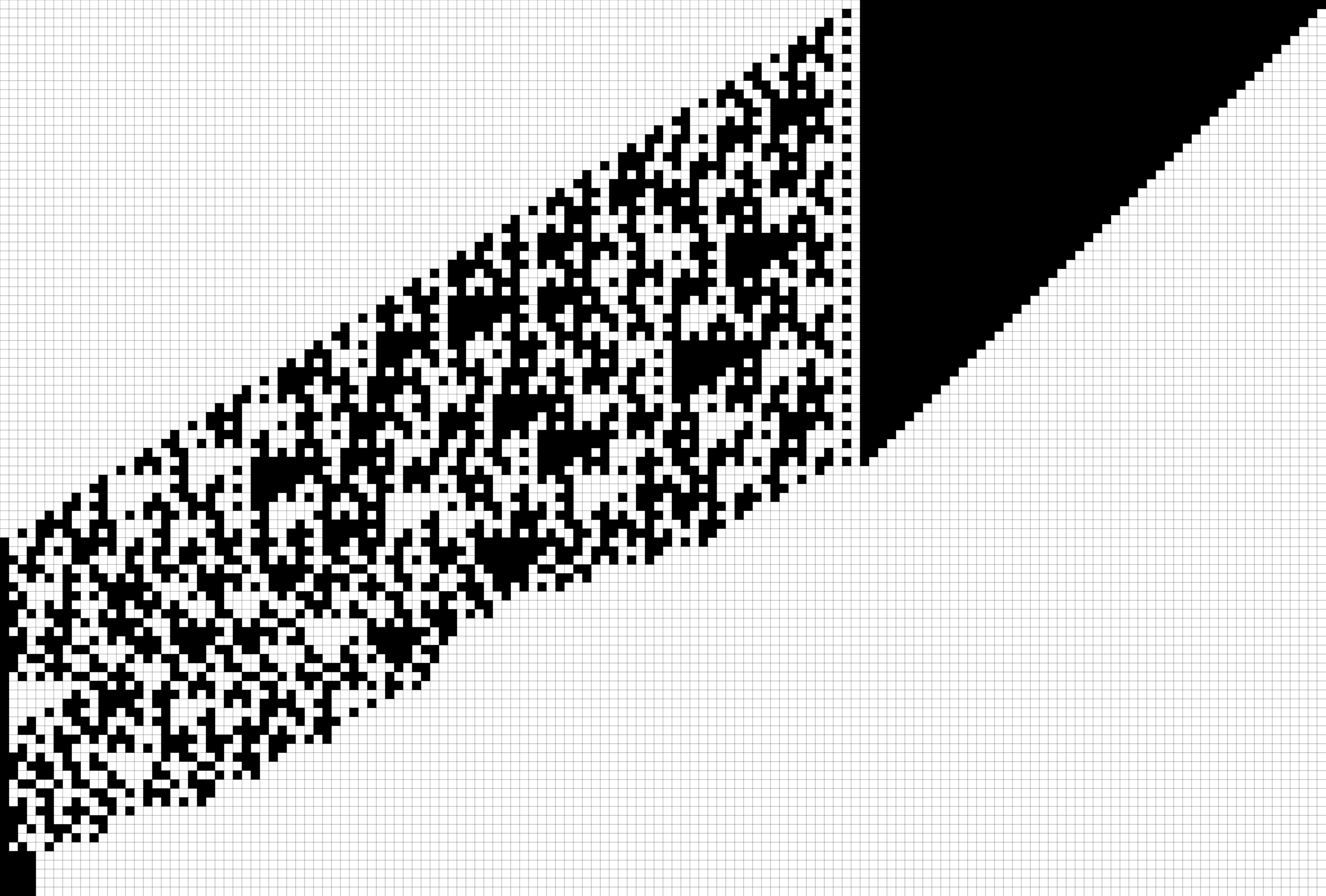
I first flipped from trying to prove it to trying to disprove it after playing with this cellular automata of the “only up” version of the conjecture.
In playing with this, it can be seen that flipping the bit in the “seed” or top row or “number”, will flip every bit in the column below it, and have chaotic effects on the bits in larger rows. Therefore, in working from small columns to large columns, the size of the number can be increased as much as is desired.
This is hardly a disproof, but having this much control feels like a number can be constructed which reconstructs itself perfectly after some amount of time, thus generating a loop.
So I began looking for it, and found a few “near misses”, among them are
| n | iterations until nearly the same | amount off by |
|---|---|---|
| 125 | 26 | 2 bits on the end |
| 207 | 15 | 1 bit on the end |
| 343 | 34 | 1 bit on the end |
Work done so far
In considering the collatz function via the lense of the only up automata, a loop is a linear propagator.
I do not expect to be able to find a number that tends off to infinity, because every bit flips all of the ones below it. So any n which tends up to infinity must continuously grow, but then each added bit on the end would introduce chaos, and by experiment we can see that there is a tendency for the chaos to lead to a decrease in the size of the number.
In thinking about constructing a linear propagator in this setup, I looked to inspiration from a living cell, which has some membrane and then the important things inside of it. This makes sense to use because there is a continuous destruction happening of at least 1 bit on the small end of the active row.
So I conducted a search for all numbers which at some point become themselves but have some “donation” of a large bit, which can be pushed into the main number. These are candidate “membranes.” For any of them, all we need to find is some internal organs, which we need not consider how they react to the “+1” or “destruction” part of the only-up-automata, but rather if they ever become themselves again, times some power of 2, after some number of donations from the membrane.
If the number is going to be a linear propagator, then it must at some point return to it’s original size, (length as a binary string). This is the flaw in the above reasoning. Because the donation adds some amount, it never has the same length, in terms of its binary representation. This is a statement for which I have no algebraic proof, only experimental evidence which has convinced me.